
Web scraping is the automated process of extracting data from websites and organizing it into formats like CSV, Excel, or JSON. Instead of manually copying information, tools handle this task efficiently and quickly. It’s used by marketers, researchers, e-commerce retailers, and analysts to gather insights from online data such as prices, reviews, and job postings.
Key Points:
- Purpose: Automates data collection from websites for analysis.
- How It Works: Sends requests to websites, extracts data from HTML, and formats it for use.
- Who Uses It: Businesses, researchers, and analysts for tasks like lead generation, competitive analysis, and AI training.
- Popular Tools: Python libraries (BeautifulSoup, Scrapy) and no-code platforms (Comment Exporter).
- Legal Considerations: Focus on public data, respect website policies, and comply with privacy laws.
Web scraping transforms unstructured web information into actionable data, making it a vital tool across industries while requiring ethical and legal care.
Learn Web Scraping with Python: A Beginner's Guide
How Web Scraping Works
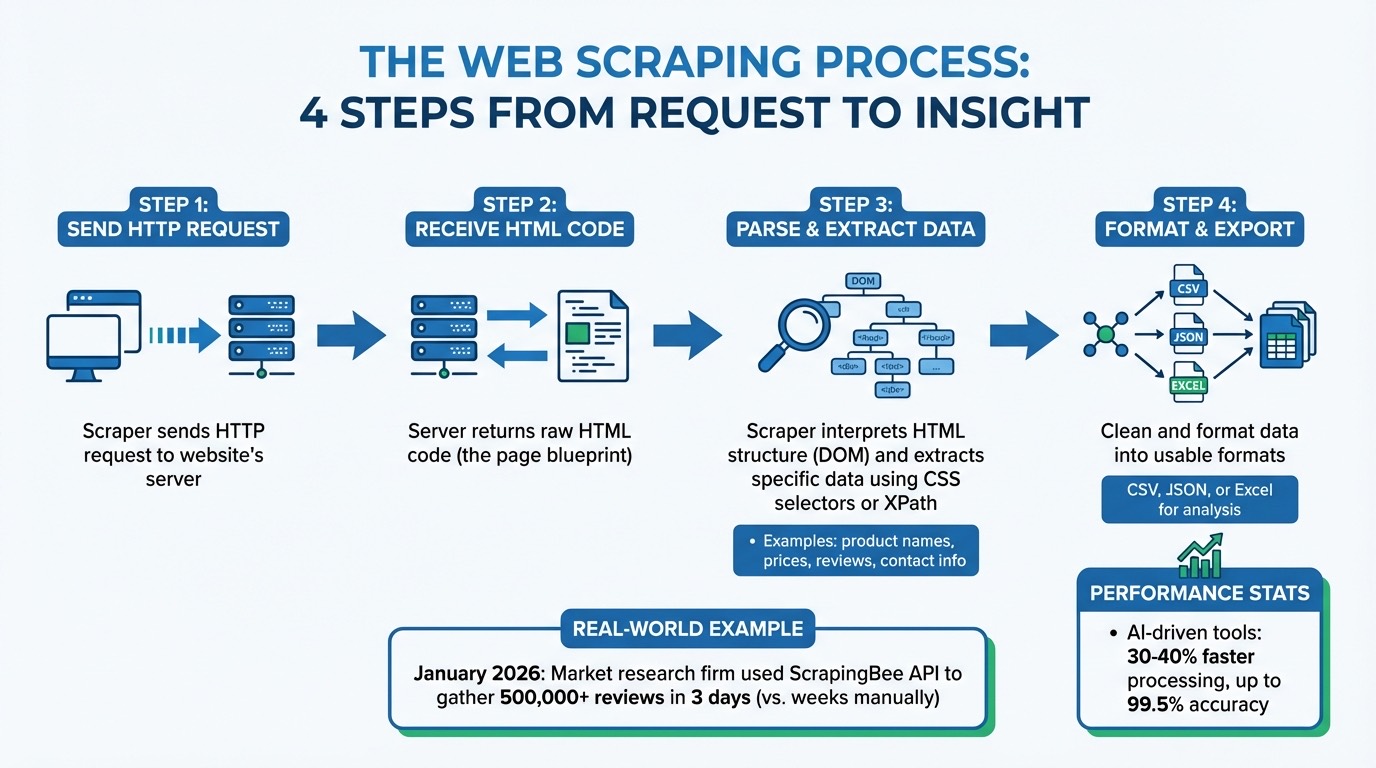
How Web Scraping Works: 4-Step Process from Request to Data
Web scraping essentially replicates what you do when browsing the internet - but at lightning speed and without the manual effort. It’s a step-by-step process that turns chaotic web pages into neatly organized data you can work with.
Steps in Web Scraping
The process kicks off with the scraper sending an HTTP request to a website's server. In return, the server provides the raw HTML code, which serves as the blueprint for everything displayed on the page.
Next, the scraper interprets the HTML structure, often referred to as the Document Object Model (DOM), to understand the layout. Using tools like CSS selectors or XPath, it pinpoints and extracts specific data - think product names, prices, reviews, or contact information. The final step involves cleaning and formatting the extracted data into user-friendly formats like CSV, JSON, or Excel for further analysis.
For instance, in January 2026, a market research firm used the ScrapingBee API to gather over 500,000 reviews in just three days - a task that would have taken weeks if done manually. Additionally, AI-driven tools now process data 30–40% faster and deliver up to 99.5% accuracy, even on JavaScript-heavy websites.
With this process demystified, let’s dive into the tools that make web scraping accessible for everyone - from seasoned developers to absolute beginners.
Tools and Programming Languages Involved
For developers, Python libraries like BeautifulSoup and Scrapy are go-to options. BeautifulSoup is ideal for parsing HTML and pinpointing specific data, while Scrapy offers a full framework for handling large-scale scraping projects. When dealing with modern sites that load content dynamically using JavaScript, tools like Selenium or Playwright step in as headless browsers, fully rendering pages before extracting the data.
For non-developers, browser extensions and cloud-based platforms simplify the process with intuitive, point-and-click interfaces. As Shuai Guan, Co-founder and CEO of Thunderbit, explains:
"Web scraping has gone from a developer's secret weapon to a must-have skill for anyone who wants to make smarter, faster decisions - no computer science degree required."
Before diving in, always check the website’s robots.txt file (by appending /robots.txt to the domain) to see what areas are off-limits for bots. To avoid server overload or an IP ban, implement rate limiting by adding delays between requests to mimic human browsing. These practices not only enhance performance but also ensure compliance with ethical and legal standards, which will be discussed further ahead.
Common Use Cases for Web Scraping
Web scraping has become a critical tool across various industries, with its global market valued at over $718 million in 2024 and expected to grow to around $2.2 billion by 2033.
Market Research and Competitive Analysis
E-commerce and retail companies use web scraping to monitor competitor pricing, inventory levels, and customer sentiment in real time. In the financial sector, professionals scrape data from SEC filings, stock prices, and alternative sources like product reviews or foot traffic patterns to gain insights for investment strategies. Similarly, real estate professionals aggregate property listings and price histories across platforms to spot undervalued opportunities.
The demand for real-time intelligence is on the rise. Instead of relying on static monthly reports, businesses now gather data hourly or daily to respond to fast-changing conditions, such as inflation spikes or sudden policy shifts. This rapid access to information helps companies act quickly - adjusting prices or addressing customer concerns - before competitors can react.
Academic Research and Data Collection
Web scraping is also transforming academic research by enabling the collection of large datasets in a fraction of the time. Researchers and AI engineers rely on scraped data to train machine learning models, conduct sentiment analysis, and study user behavior patterns. Abigail Jones, a Data Analyst at Octoparse, emphasizes its importance:
"Without scraping, modern AI wouldn't exist. Period".
The data collected supports projects in natural language processing and computer vision, using publicly available text, images, and videos to develop advanced algorithms.
Universities and research institutions also use scraping to gather public records, social media posts, and forum discussions for demographic studies and trend analysis. By compiling thousands of data points in hours rather than months, researchers can adopt more dynamic and efficient methods.
Generating Leads and Monitoring Reviews
Businesses leverage web scraping to enhance customer outreach and refine feedback processes. Sales and marketing teams extract contact details from business directories, LinkedIn profiles, and professional networks for lead generation and CRM updates. HR teams scrape job boards to benchmark salaries, track in-demand skills, and analyze competitors' job offers.
For review monitoring, companies scrape platforms like Amazon, Walmart, and YouTube to collect star ratings, reviewer details, timestamps, and comments. This data fuels sentiment analysis, helping businesses identify product issues, feature gaps, and evolving consumer preferences. For instance, in January 2026, a market research firm used the ScrapingBee API to collect over 500,000 reviews in just three days. Tools like Comment Exporter simplify this process by exporting structured data in formats like CSV or JSON, making analysis faster and more efficient.
Media and PR teams also scrape news websites and social platforms to track brand mentions and competitor coverage in real time. This allows them to respond swiftly to reputation challenges or take advantage of positive press.
sbb-itb-eded204
Legal and Ethical Guidelines for Web Scraping
To extract data responsibly, it’s crucial to understand the legal boundaries and follow ethical practices. These principles help you use web scraping effectively while reducing potential risks.
Is Web Scraping Legal?
Scraping publicly accessible data is typically allowed, but the legality depends on what you scrape, how you do it, and why. For instance, the Ninth Circuit's 2022 ruling in hiQ Labs v. LinkedIn clarified that accessing public data doesn’t violate the Computer Fraud and Abuse Act (CFAA). Similarly, in 2024, a federal court in Meta v. Bright Data determined that scraping public data from Facebook and Instagram didn’t breach the CFAA because no security measures were bypassed.
However, scraping restricted or protected data can lead to legal issues. Copyright and privacy laws add another layer of complexity. The Supreme Court's decision in Feist Publications v. Rural Telephone Service (1991) established that raw factual data - like prices or business hours - can’t be copyrighted because facts lack creative expression. On the other hand, scraping creative works such as articles or images could result in copyright claims, with damages reaching up to $150,000 per work for intentional infringement. Privacy laws, like the California Consumer Privacy Act (CCPA), further impose strict guidelines for handling personal data, with penalties of up to $7,500 per violation.
Understanding these legal frameworks is key to adopting ethical web scraping practices.
Best Practices for Ethical Scraping
Start by checking the website’s robots.txt file to identify any restricted sections. If the site offers an official API, use it instead of scraping - it’s a structured and authorized way to access data.
To avoid overloading servers, use rate limiting. For example, send one request every 10–15 seconds for smaller websites or 1–2 requests per second for larger platforms. Schedule scraping tasks during off-peak hours and, if faced with a 429 (Too Many Requests) error, apply exponential backoff - gradually increasing wait times between retries.
Be transparent by setting a custom User-Agent string that includes your company name and contact email. This allows website administrators to reach out to you before escalating issues. Collect only the data you truly need, a practice known as data minimization, which reduces bandwidth usage and privacy risks. Avoid scraping personal information - such as names, emails, or phone numbers - unless you have a lawful reason to do so, as this triggers compliance obligations under regulations like GDPR and CCPA.
"The line between legal scraping and legal trouble often comes down to whether you're being respectful or aggressive."
Following these guidelines helps you navigate web scraping responsibly and prepares you to explore the tools available.
Getting Started with Web Scraping Tools
Once you're clear on the legal and ethical aspects of web scraping, the next step is selecting the right tool for the job. With over 65% of organizations using web scraping to build AI models and gather specialized datasets, it's clear this practice is pivotal in data collection today. Below, we dive into three tools that can simplify your scraping process.
Tools Overview: BeautifulSoup, Scrapy, and Comment Exporter
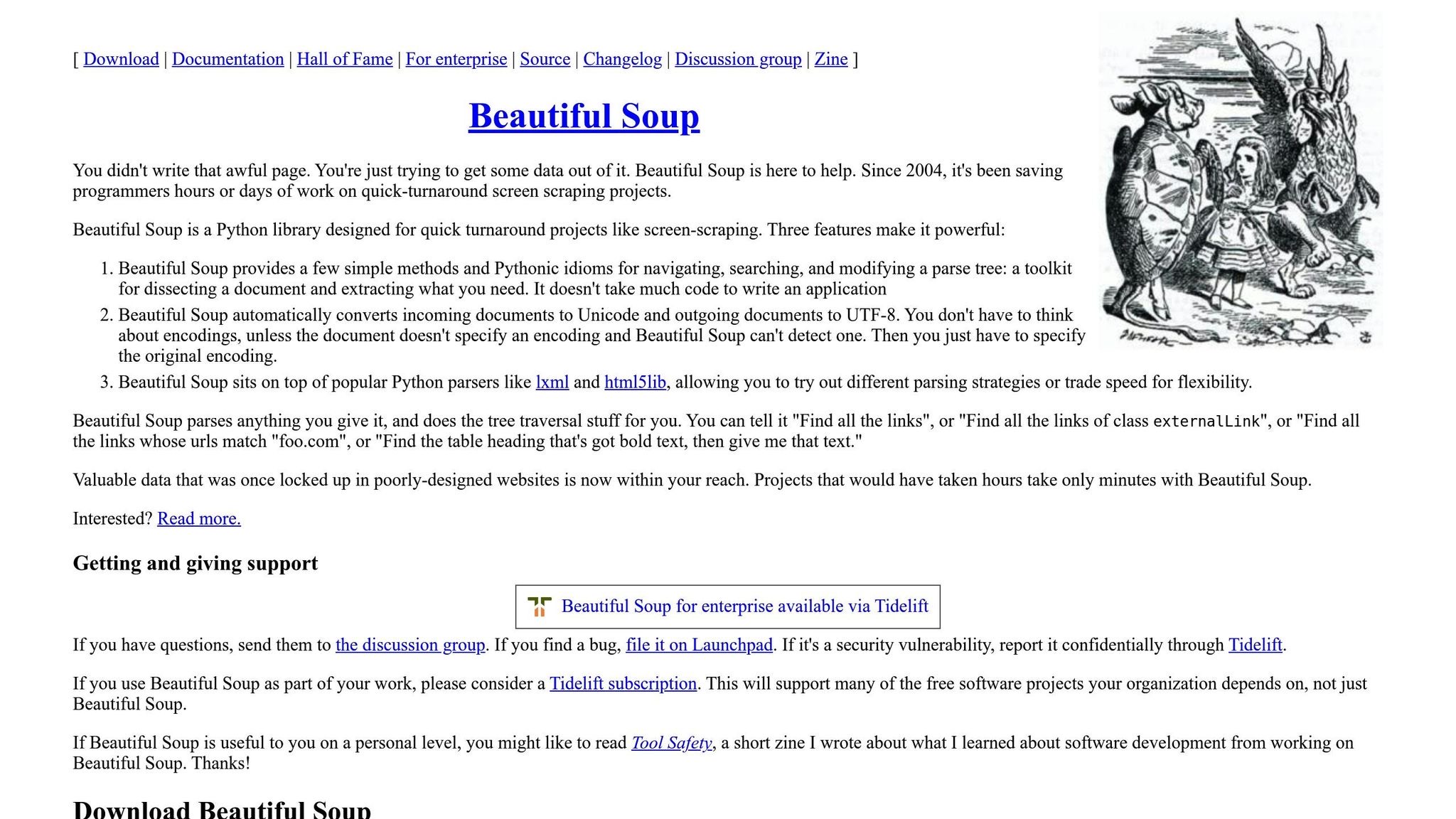
BeautifulSoup is a Python library designed for parsing HTML and XML. If you’re comfortable with basic Python, this tool is perfect for extracting data from static websites. However, you'll need to pair it with a library like requests to fetch web pages. Martin Breuss of Real Python explains:
"Beautiful Soup is a useful tool in your web scraping toolkit, allowing you to conveniently extract specific information from HTML, even from complex static websites".
A handy feature is its .prettify() method, which formats HTML neatly, making it easier to locate the elements you want to scrape.
Scrapy, on the other hand, is a comprehensive Python framework designed for large-scale web scraping projects. Unlike BeautifulSoup, Scrapy handles everything from crawl queues to retries and data pipelines. This makes it ideal for advanced users managing high-volume scraping tasks, as it supports features like concurrency and throttling out of the box.
Comment Exporter is a Chrome extension tailored for non-technical users. It’s great for extracting comments and reviews without writing any code. Supporting nine platforms - including Reddit, YouTube, Amazon, and Quora - it processes data locally, ensuring privacy. Reddit exports are free, while a Starter plan costs $49/month. With over 1 billion comments exported for more than 100,000 users, it boasts a 99% success rate.
| Tool | Type | Best For | Skill Level | Cost |
|---|---|---|---|---|
| BeautifulSoup | Python Library | Parsing static HTML | Intermediate (Python) | Free |
| Scrapy | Framework | Large-scale crawling | Advanced | Free |
| Comment Exporter | Chrome Extension | Reviews and social media | Beginner | Free (Reddit); $49/month (Starter) |
Whether you're a coding enthusiast or someone looking for a no-code solution, these tools offer a range of options to suit your needs.
Exporting and Analyzing Data
Extracting data is just the beginning. To turn raw data into actionable insights, you’ll need robust export and analysis capabilities. Most scraping tools let you export data in formats like CSV, JSON, or Excel (XLSX), making it easy to analyze in spreadsheets or integrate into other applications. Comment Exporter takes this a step further by capturing rich metadata, such as usernames, profile links, timestamps, like counts, reply counts, and even nested conversations. This structured data is invaluable for tasks like sentiment analysis, keyword tracking, and identifying peak activity times.
For platforms like Facebook or Instagram, enabling the "Include Nesting Comments" option ensures you capture all threaded replies. If you need ongoing updates, the ExportComments.com web app offers automated scheduled exports. These can be delivered via email or webhook on an hourly, daily, or weekly basis, making it easy to stay on top of new data.
Conclusion
Web scraping has grown from a niche skill to a critical tool for businesses. With the market projected to hit $2.2 billion by 2033, it's changing how companies harness publicly available data. Whether you're monitoring competitor pricing, studying customer feedback, or gathering research, scraping helps turn raw web data into insights that lead to smarter decisions.
As this field expands, ethical practices are more important than ever. It's essential to respect robots.txt files and comply with data privacy laws like GDPR and CCPA. Karan Sharma from PromptCloud explains:
"Web scraping is legal when you: Scrape publicly accessible, non sensitive data; Avoid logins, walls, and protected content; Respect robots.txt and site policies".
Getting started with web scraping doesn't require a computer science background. With the right tools, anyone can dive in. Python-based options like BeautifulSoup and Scrapy cater to those with coding skills, while tools like Comment Exporter offer a no-code alternative for extracting comments and reviews from platforms like Reddit, YouTube, and Amazon for $19.99/month.
Web scraping isn't just about gathering data - it's about reshaping how you understand your industry, customers, and competitors. Start with manageable projects, follow ethical guidelines, and choose tools that match your expertise. By combining the right tools with responsible practices, businesses can consistently uncover insights that drive competitive advantages.
To turn comments and reviews into ad angles, see voice of customer research and Adlicio pricing.